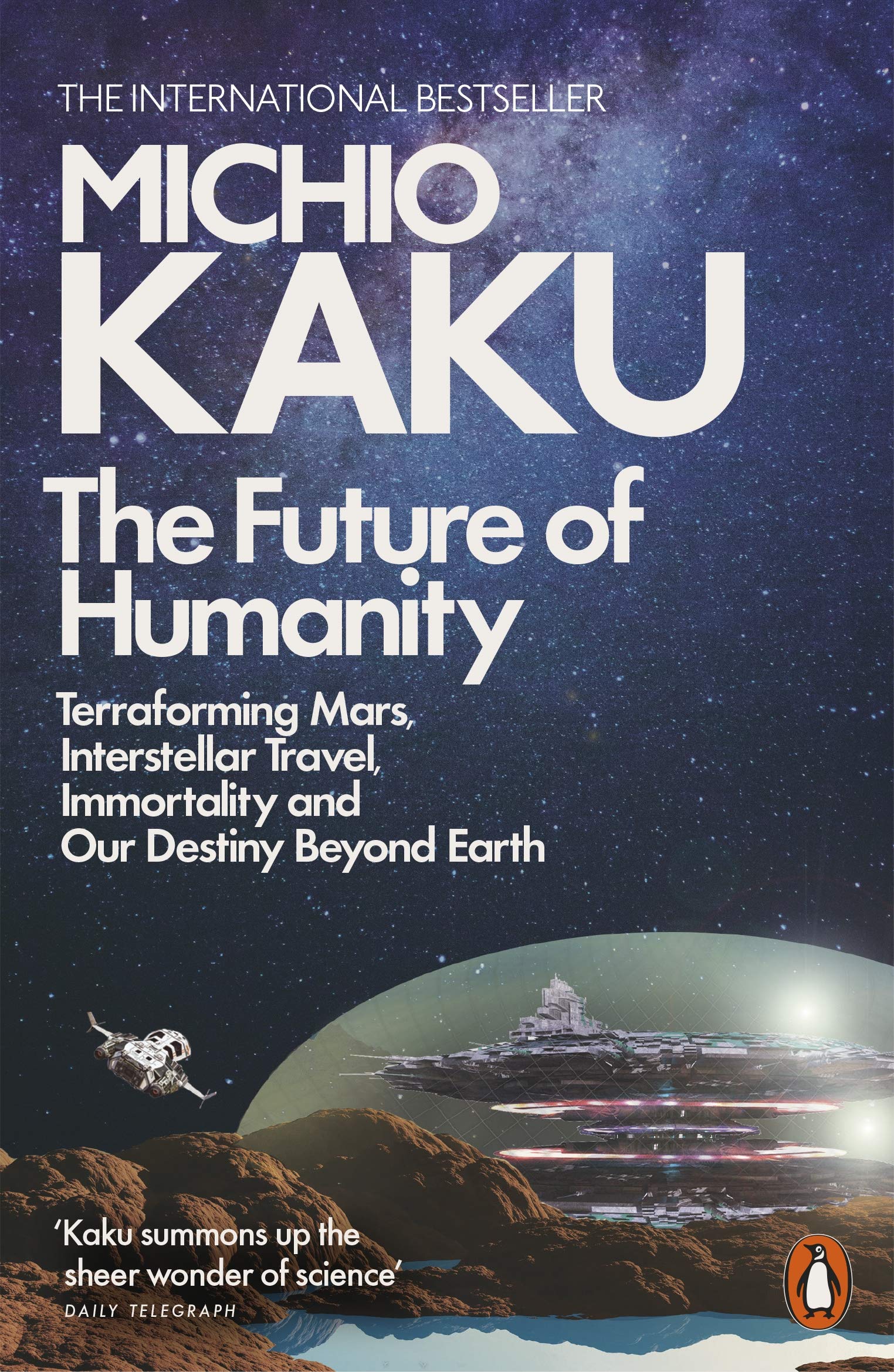
The Future of Humanity by Michio Kaku
A sweeping journey from humanity’s distant past to a possible future among the stars. The Future of Humanity is ambitious, speculative and full of ideas that make you wonder just how extraordinary our species might eventually become.
Why I read it
I’ve always been fascinated by the really big questions: where humanity came from, where we might be going, whether we will eventually become a multi-planetary species, and whether things like faster-than-light travel could ever move from science fiction into science. So The Future of Humanity was an obvious book for me.
Michio Kaku essentially takes us on a journey from humanity narrowly surviving catastrophe tens of thousands of years ago to a possible future billions of years from now, when our descendants may have spread throughout the galaxy, mastered extraordinary technologies and perhaps even found ways to survive the eventual death of the universe.
That is quite a journey for one book.
The central idea
The central argument is that if humanity is going to survive in the very long term, we will eventually have to leave Earth. Earth is an extraordinary home, but it is also a single point of failure. Asteroid impacts, super volcanoes, environmental catastrophe and, on sufficiently long timescales, the evolution and eventual death of the Sun mean that remaining permanently confined to one planet cannot be humanity’s final destination.
Kaku therefore explores how we might gradually become a spacefaring civilisation: first returning to the Moon, then colonising Mars, spreading throughout the solar system and eventually attempting to reach other stars. From there, things become considerably more ambitious.
The book explores artificial intelligence, genetic engineering, suspended animation, fusion propulsion, antimatter engines, laser sails, wormholes, warp drives and higher dimensions. Kaku then uses ideas such as the Kardashev scale to imagine civilisations capable of harnessing increasingly extraordinary amounts of energy.
Eventually, he asks one of the biggest questions imaginable: could an advanced civilisation somehow survive the death of the universe itself?
What I liked
The thing I enjoyed most was the sheer scale of the book. Kaku forces you to stop thinking in years and decades and start thinking in thousands, millions and billions of years. Seen from that perspective, human civilisation feels incredibly young. Rather than living towards the end of technological history, perhaps we are still somewhere near the beginning.
I also loved the science. Some of it is established physics, some sits at the theoretical frontier and some is highly speculative. I didn’t mind that at all. Kaku is at his best when he takes something that sounds like science fiction and asks whether known physics actually rules it out. The sections on faster-than-light travel were particularly interesting to me.
Einstein’s relativity tells us that we cannot simply accelerate an object through space beyond the speed of light. But there are intriguing theoretical possibilities that seek to circumvent the problem by manipulating spacetime itself. Could we create wormholes between distant parts of the universe? Could a warp drive compress space in front of a spacecraft and expand it behind? Could higher dimensions provide shortcuts through the cosmos?
There are enormous theoretical and engineering problems with all of these ideas, and some may prove impossible. But I find the fact that physics even allows us to discuss them seriously fascinating.
I also enjoyed Kaku’s discussion of increasingly advanced civilisations. The idea that humanity could one day progress from using the energy available on Earth to harnessing stars, galaxies and eventually energy on a cosmic scale is almost impossible to comprehend.
Personally, I rather like the idea that humanity might eventually become something approaching a Type IV civilisation and start living in hyperspace. We may have a few engineering challenges to solve first.
What challenged me
The book made me think much more seriously about humanity’s long-term future. If becoming a multi-planetary civilisation is genuinely possible, then what can those of us alive now do to move humanity a little further towards it?
I’m obviously not going to build the first city on Mars myself. But enormous advances rarely come from a single heroic breakthrough. They are built through generations of scientific discoveries, engineering improvements, new technologies, better education and people willing to pursue ideas that initially sound ridiculous. That made the book feel strangely motivating.
We are living at a remarkable point in human history. Space exploration is accelerating. Artificial intelligence is progressing rapidly. Biotechnology is advancing. Our ability to understand and manipulate the physical world continues to improve. It made me think more about what kind of problems are actually worth spending a life working on. There is something appealing about contributing, however modestly, to the accumulation of knowledge and capability that might eventually allow humanity to explore further, survive longer and understand more.
What I didn’t like as much
If I had to choose something, there are moments when Kaku moves very quickly from established science into highly speculative possibilities. That is part of the fun of the book. Still you do occasionally have to remind yourself that discussing something within the laws of theoretical physics is very different from demonstrating that humanity will ever actually be able to build it.
Warp drives, wormholes and travel through higher dimensions are fascinating possibilities, but enormous gaps remain between the mathematics and anything resembling a practical technology. That said, I would rather read a scientist willing to explore ambitious possibilities than a book afraid to speculate at all.
Who should read it
I’d recommend The Future of Humanity to anyone interested in physics, space exploration, technology or the long-term future of humanity. You definitely do not need to be a physicist. Kaku writes for a general audience and explains most of the scientific ideas intuitively rather than burying the reader in equations.
It is particularly good for people who enjoy the borderlands between science and science fiction: the places where ideas such as Mars colonies, artificial intelligence, immortality, warp drives and higher dimensions sound outrageous today but cannot necessarily be dismissed as impossible forever. Above all, it is a book for people who enjoy asking very big questions.
Final verdict
I really enjoyed The Future of Humanity. It is ambitious, occasionally speculative and sometimes completely bonkers, but that is a large part of its appeal. Kaku takes a genuinely enormous subject and makes you feel excited about what humanity might eventually become.
It also strengthened something I already felt quite strongly: becoming a multi-planetary species is a worthwhile ambition. Not because Earth is disposable, but precisely because humanity is valuable. Over sufficiently long periods of time, putting the entire future of our species on one planet seems unnecessarily risky.
And then there is the slightly selfish thought that stayed with me after finishing the book. Human beings have spent our entire history accepting ageing and death as unavoidable. Advances in medicine, biotechnology, genetics and AI may eventually challenge some of those assumptions too. Nobody knows how far that will go, but the possibility itself is fascinating.
I was born in 1983, which probably puts me far too early for immortality, hyperspace and weekend trips to Alpha Centauri. But maybe not. After reading The Future of Humanity, I rather like the idea that humanity’s most extraordinary chapters are still ahead of us. I hope I get to read a few of them.
A final note: I borrowed this book from my local library rather than buying it. Libraries remain one of the best ways we have of giving everyone access to books, knowledge and ideas, and they are very easy to take for granted.
Support your local library. Use it or lose it.