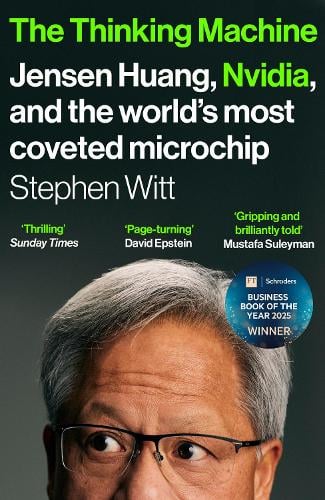
The Thinking Machine by Stephen Witt
The Thinking Machine tells the remarkable story of Nvidia and the AI revolution, but leaves the man at the centre of it all — Jensen Huang — frustratingly difficult to understand.
Why I read it
I’m currently on what I’m calling My AI Odyssey: trying to understand artificial intelligence properly, not just as a user of tools, but as someone who wants to understand the technology, the people building it, and how we arrived at this extraordinary moment.
Nvidia is impossible to ignore in that story. The company has gone from building graphics chips for gamers to becoming one of the most important businesses in the AI revolution. And at the centre of Nvidia for more than three decades has been Jensen Huang.
I picked up The Thinking Machine because I wanted to understand both: how Nvidia became so important, and the man who made many of the decisions that got it there. I certainly understand Nvidia better. I’m still not sure I understand Jensen Huang.
The central idea
The book is really the story of how Nvidia evolved from a graphics-chip company into one of the fundamental technology platforms underpinning modern artificial intelligence. That journey involves GPUs, gaming, CUDA, deep learning, supercomputing and, eventually, the explosion of large language models and generative AI.
One of the most interesting parts of the story is that Nvidia did not simply wake up one morning and discover that its chips happened to be useful for AI. The company made a series of long-term technical and strategic bets that, in hindsight, positioned it extraordinarily well.
CUDA is probably the most important example. Nvidia invested heavily in turning its GPUs into something scientists and developers could programme for purposes far beyond graphics. For years, it was far from obvious how valuable that decision would become.
Then deep learning arrived. Suddenly, the parallel computing capabilities of GPUs were exactly what researchers needed. The rest, as they say, is a rather expensive piece of Silicon Valley history.
What I liked
The strongest part of The Thinking Machine is the story of Nvidia itself. It gives you a much better appreciation of how GPUs became so central to modern AI, and how Nvidia gradually built the technology, software and ecosystem that now sits underneath much of the AI industry.
I particularly enjoyed the sections covering CUDA, deep learning and the emergence of large language models. It helps connect a lot of the dots between computer graphics, neural networks and the enormous computing requirements of modern AI.
It also reminds you how strange technological progress can be. A company founded to improve computer graphics ends up providing much of the computational infrastructure for artificial intelligence. That is not a straight line. It is a mixture of technology, persistence, timing, judgement and some very large bets.
What challenged me
What stayed with me most was Huang’s decision-making. What comes through in the book is his almost uncanny ability to become deeply informed about a subject and then, at some point, trust his intuition. He seems to absorb huge amounts of information, understand the technology in considerable depth, talk to people across the organisation and industry, and then make a judgement about where the world is going.
And sometimes he makes that judgement long before the evidence is conclusive. That is interesting because we often talk about good decision-making as though more data will eventually reveal the correct answer. Sometimes it won’t. There comes a point where the information runs out, and judgement begins.
Some of Nvidia’s most important decisions were bets. Investing in CUDA was a bet. Pushing GPUs beyond graphics was a bet. Committing heavily to artificial intelligence before its commercial potential was obvious was a bet. In another version of history, some of those decisions might have failed spectacularly. That matters because success creates hindsight bias. Once Nvidia becomes one of the most valuable companies in the world, every earlier decision starts to look inevitable.
It wasn’t.
My main takeaway
My biggest takeaway from the book is that extraordinary outcomes sometimes require informed risk. Huang does not appear to be someone who simply follows his gut and hopes for the best. The intuition seems to come after enormous amounts of learning, questioning and thinking. That distinction matters.
Intuition without knowledge is guessing. But intuition built on deep understanding can sometimes allow you to make a decision before the spreadsheet, market research or consensus has caught up. Of course, that still does not guarantee success. Some bets fail. But if you only make decisions where the outcome is already obvious, you are probably unlikely to achieve anything particularly extraordinary.
That is perhaps the most useful thing I took from Huang: get informed, understand the problem deeply, and then have the courage to make a judgement when certainty is impossible.
What I didn’t like as much
For a book with Jensen Huang so prominently at its centre, I finished it knowing surprisingly little about Jensen Huang. He is everywhere in the story but somehow remains strangely elusive. Even when the author has direct access to him, you rarely feel that you get particularly close to understanding the man himself: what really drives him, where his intensity comes from, what he fears, how he thinks privately, or how he developed his distinctive approach to leadership.
One of the most revealing moments comes near the end of the book, when Huang effectively tears into the author during an interview. It is fascinating and slightly uncomfortable. But even that encounter feels oddly obscure. You sense something important about Huang’s personality, standards and intensity, yet he remains difficult to pin down. Perhaps that is partly the point.
He seems simultaneously charismatic and guarded, extremely public yet surprisingly private. So, I enjoyed The Thinking Machine. As a history of Nvidia and an explanation of how GPUs became one of the foundations of modern AI, it is excellent. As a portrait of Jensen Huang, it left me wanting considerably more.
Final Verdict
I finished the book understanding the machine. The man behind it remains something of an enigma.