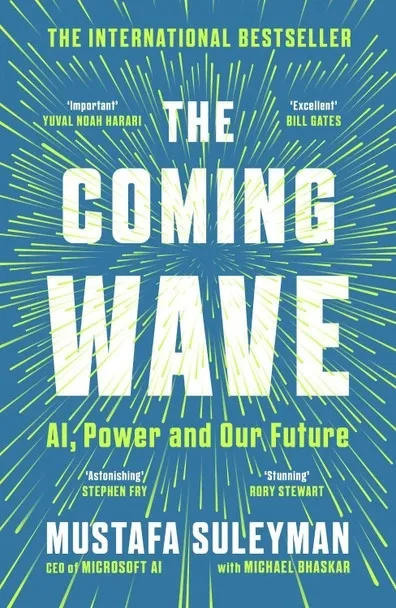
The Coming Wave by Mustafa Suleyman
A big, serious, slightly terrifying book about AI, power, and the problem of containment.
Why I read it
I’m currently on what I’m calling My AI Odyssey: trying to understand artificial intelligence properly, not just as a user of tools, but as someone who wants to think clearly about where this technology is going and what it might mean for business, society, and the future of work.
The Coming Wave felt like an obvious stop on that journey.
Mustafa Suleyman is one of the co-founders of DeepMind, so he is not writing as an outsider peering through the window at AI. He has been inside the machine room. That makes the book especially interesting, because it combines excitement about technological possibility with a very serious warning about what might happen if powerful technologies spread faster than our institutions can handle.
The central idea
The book’s core argument is that humanity is facing a new technological wave, driven mainly by artificial intelligence and synthetic biology. Suleyman’s point is not simply that these technologies will be powerful. It is that they will be both powerful and increasingly accessible. That combination is what makes them so difficult to control.
Previous waves of technology changed the world, but many required massive infrastructure, huge capital, or state-level resources. The coming wave is different. AI models, biological tools, automation systems, and software capabilities could eventually be available to individuals, small teams, companies, governments, and bad actors alike.
That is the frightening bit. The question running through the book is: How do we contain technologies that are becoming more capable, more general-purpose, and easier to access?
What I liked
The strongest thing about The Coming Wave is its sense of scale. It does not treat AI as just another business productivity tool. It places it in the context of previous technological revolutions: agriculture, the printing press, electricity, computing, the internet. That wider lens is helpful because it forces you to think beyond “how can I use ChatGPT to write emails faster?”
This book asks bigger questions:
- What happens when intelligence becomes cheap?
- What happens when more people can build powerful systems?
- What happens when biology becomes programmable?
- What happens when institutions designed for the 20th century face technologies moving at 21st-century speed?
- What does governance look like when the thing being governed keeps changing?
I also liked that the book avoids both naive optimism and simple doom-mongering. Suleyman clearly believes these technologies could produce enormous benefits. But he is also deeply concerned about misuse, concentration of power, surveillance, cyber risk, biological risk, economic disruption, and the general inability of governments to move quickly enough.
That balance makes the book more useful than the usual AI hype cycle.
What challenged me
The most challenging idea in the book is containment. Suleyman argues that the history of technology is, in many ways, the history of proliferation. Once something useful is invented, it tends to spread. People copy it, improve it, commercialise it, weaponise it, democratise it, and remix it.
That creates a problem. If AI is genuinely powerful, people will want access to it. Companies will race to build it. Governments will want strategic advantage from it. Open-source communities will push it forward. Criminals will exploit it. Ordinary people will use it in unpredictable ways. So “just regulate it” sounds simple, but becomes incredibly difficult in practice.
That made me think about SMEs too. Smaller businesses often adopt technology late, cautiously, and unevenly. But AI may not follow the same pattern as traditional enterprise software. It may seep into everything: sales, operations, finance, customer service, forecasting, marketing, reporting, decision-making.
The coming wave will not arrive as one big system implementation. It may arrive as a thousand small tools quietly changing how work gets done.
My main takeaway
My biggest takeaway is this: AI is not just a tool. It is an infrastructure-level shift in how decisions, knowledge, creativity, and work may be produced. That does not mean every company needs to panic. But it does mean leaders need to pay attention.
For SMEs, the challenge will be especially interesting. Big companies may have AI teams, governance frameworks, legal departments, and transformation budgets. Smaller businesses will often have messy data, stretched teams, old systems, and very little time to think strategically.
That could make AI either a huge advantage or another source of confusion. The businesses that benefit will probably not be the ones that chase every shiny AI tool. They will be the ones that understand their own problems clearly, improve their data foundations, and use AI in practical, focused ways.
What I didn’t like as much
At times, the book can feel huge in scope. AI, synthetic biology, geopolitics, regulation, state power, capitalism, open-source technology, national security, and human nature are all swirling around together. That is part of the point, but it can sometimes make the reader feel like they are standing in front of a tidal wave holding a clipboard.
There are moments where I wanted more practical detail on what individuals, businesses, and smaller organisations should actually do. The book is excellent at framing the scale of the problem. It is less of a practical manual. But maybe that is unfair. It is not trying to be “AI Strategy for Dave’s Plumbing Supplies.” It is trying to describe the shape of a civilisational challenge.
Who should read it?
I’d recommend The Coming Wave to:
- anyone trying to understand AI beyond the hype
- business leaders wondering what AI might mean strategically
- policymakers and technology leaders
- people interested in the future of work
- anyone building, buying, or governing AI systems
- curious readers who like big-picture technology books
It is especially useful if you want to move beyond “AI will make us more productive” and think about the deeper consequences.
Final verdict
The Coming Wave is one of the most important AI books I’ve read so far on my AI Odyssey. It made me more excited about AI, but also more cautious. It made me think about opportunity, but also responsibility. Most of all, it reminded me that powerful technologies do not arrive neatly. They spill, spread, mutate, and reshape the world around them.
For Drakeley Labs, this book reinforces a central idea: the future belongs not just to people who use AI, but to people who can think clearly about it.
A big, serious, slightly terrifying book — and a very good place to start if you want to understand why AI matters.